— We hope the PuNolChi Mind Table culture brings peace to the world
We invite everyone who longs for a flourishing life to the “5-Minute Positivity Table,” which makes life steady and strong.
"Beginning and end — adding deep meaning to life through a constant bond of 20 years…"
A project to build a healthy and happy world with the Positivity Table
"How can I become happy?" Beneath this question lies the hidden wish, “I want to be happier.” Underneath is a longing for a happiness that is not yet fulfilled. But from now on, as positive psychologists suggest, how about asking this instead: “Why am I happy?” Because happiness is already within us, or within reach as soon as we decide and stretch out our hand.
If you type the word “happiness” into an internet search site, hundreds of millions of related results appear. This shows how much people care about happiness and want it. Happiness has been the ultimate good and purpose that humans have pursued ceaselessly since the birth of humankind. That is why, from ancient times to today, people in many fields — philosophers, social psychologists, brain scientists, cognitive biologists and more — must have studied happiness to unlock the secrets of this realm of the heart.
I, too, was very interested in happiness. From childhood, when I first began to understand the world, I thought, “I wish I could be happy, and the people around me could be happy too.” As a child, it seems I only read fairy tales that ended with “and they lived happily ever after.”
I have always believed that, when it comes to happiness, theory and practice should be one and should actually help in life. Study (theory, learning) and living (practice, action) should not be separate; theory should be applied to life and melt into everyday living. So I wanted to write practical psychology books that apply to life by uniting theory and practice.
We, the authors who have been together for more than 20 years, have pondered this together. As a result, five years ago we began preparing the Positivity Table project, which makes it easy to apply and practice Food Expressive Arts Therapy theory in everyday life. It is a psychology on the dining table: chewing our food thoroughly in daily life and embodying positive thoughts in our lives.
The first theme we chose was to practice positive psychology in daily life — at the dining table — and to chew and savor happiness and health.
At the table, recalling and savoring a positive heart while chewing slowly and thoroughly
The Positivity (Happiness) Table is based on Professor Martin Seligman’s positive psychology — scientifically studied and proven since the late 20th century — and on Food Expressive Arts Therapy. Positive psychology is already a well-known theory. Most people agree that living positively makes you happy. Yet it can feel overwhelming to know how to apply it to real life. So the three of us — Pooh, Bora and Healing Santa — fused positive psychology with the healthy and delicious creative-fusion theory of Food Expressive Arts Therapy, and coined the term “Positivity Table” for a project that practices positive psychology at every daily meal. In other words, we started with the idea of uniting theory and practice while eating, making life happy as a healing art.
Positive psychology + Food Expressive Arts Therapy ⇒ Food Expression Positive Psychotherapy ⇒ PuNolChi Mind Journey ⇒ 5-Minute Happiness (Positivity) Table
In terms of meaning alone, “food expression positive psychology” would be the right term, but to apply it while eating in daily life — in the sense of “let’s eat a food-expression Mind Table filled with positive emotions” — we named it the “Positivity Table.”
Food Expressive Arts Therapy was first started in Korea 20 years ago by Kim Ji-yu, and its theory was systematized and developed by Dr. Kang Min-ju and Dr. Kim Min-yong, who began the research together. Dr. Kim Min-yong wrote his doctoral dissertation by gathering the healing effects observed by colleagues who had practiced food expressive counseling for more than 20 years. As a result, Food Expressive Arts Therapy, developed in Korea for the health and happiness of humanity, has now become a K-Therapy (Korea Therapy) that can widely share its healing effects with the whole world.
For five years now I have proudly used the term K-Therapy. I thank Professor Choi Dong-ju of the Department of Food Service Industry and Culinary Arts at Jeonju University, who encouraged me five years ago by telling me that Food Expressive Arts Therapy is a K-Therapy.
And now, with Dr. Kim Min-yong’s doctoral dissertation exploring the therapeutic factors of Food Expressive Arts Therapy, I am deeply moved that we can say with even more confidence that Food Expressive Arts Therapy is a K-Therapy. I am grateful to President Kim Min-yong, who organized more than 20 years of therapeutic results of Food Expressive Arts Therapy into a concept-mapping study. I also sincerely thank Dr. Kang Min-ju — a Food Expressive Arts Therapy expert and researcher who has been with me for over 20 years — who, following me, researched the effects of PuNolChi in the second doctoral dissertation on Food Expressive Arts Therapy. She came into my life like a gift, and our wonderful bond has continued unchanged for more than 20 years.
Most counseling theories used in Korea came from abroad. By contrast, the late Yoo Dong-soo of the Korean Counseling Society (Han-sangdam) keenly felt the need for a counseling theory suited to Korean emotions and culture, and developed and taught Han-counseling theory. Having built up study and experience in psychological counseling, I fully agree with his view on the importance of Korean emotions and culture. So 20 years ago, while receiving his sensitivity training, the wish began to sprout in me to create an everyday therapy suited to Korean sensibilities.
Now I believe that PuNolChi — as a Korean healing art of life and an everyday therapy — can make the dream of “globalizing K-Therapy” come true.
"Now you can become happy with the ‘5-Minute Positivity Table’!"
Just as Professor Martin Seligman wrote in the preface to Flourish that “to be happy, practice PERMA,” we are simply grateful that we, too, can now say it with one voice, confidently and clearly.
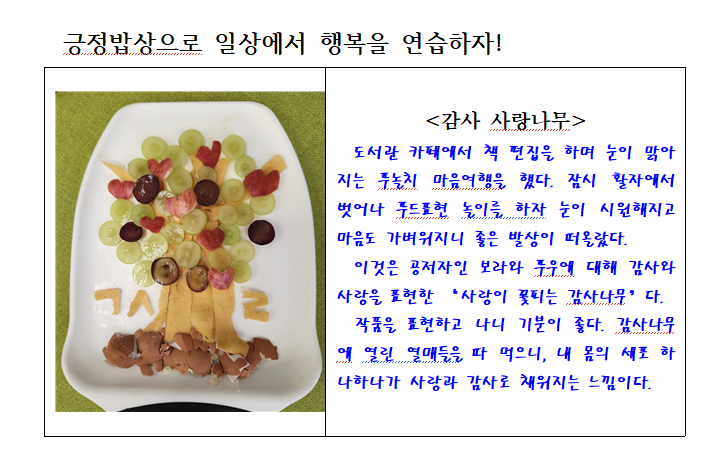
<Tree of Gratitude and Love> — While editing a book at a library café, I took a PuNolChi Mind Journey that cleared my eyes. When I stepped away from the printed words for a moment and played with food expression, my eyes felt refreshed, my heart grew lighter and good ideas came to me. This is a “Tree of Gratitude where Love Blooms,” expressing gratitude and love for my co-authors Bora and Pooh. I feel good after making it. Eating the fruits from the gratitude tree, I feel every cell of my body being filled with love and gratitude.
Psychology on the Dining Table — the fourth story
As long as we live, we have to eat anyway. Then why not practice, even for just five minutes a day, a psychology on the dining table — eating health and happiness and training positive psychology at our own table?
This is the fourth book in the PuNolChi Mind Table series, Psychology on the Dining Table. With people who have walked together for a long time, we capture our daily journeys in <The 5-Minute Positivity Table>, and share them with the public through PuNolChi healing essays and PuKaShi.
This book tells how we practiced PERMA — which Professor Seligman proposes for the flourishing of happiness and a life of well-being — with PuNolChi, eating positivity at the table.
Just as a flourishing life (Flourish: happiness in full bloom, the goal of well-being) unfolded for us through the food-expression Positivity Table, we hope and cheer that happiness will bloom beautifully in everyone’s life through the Happiness Table that trains positive psychology and through PERMA.
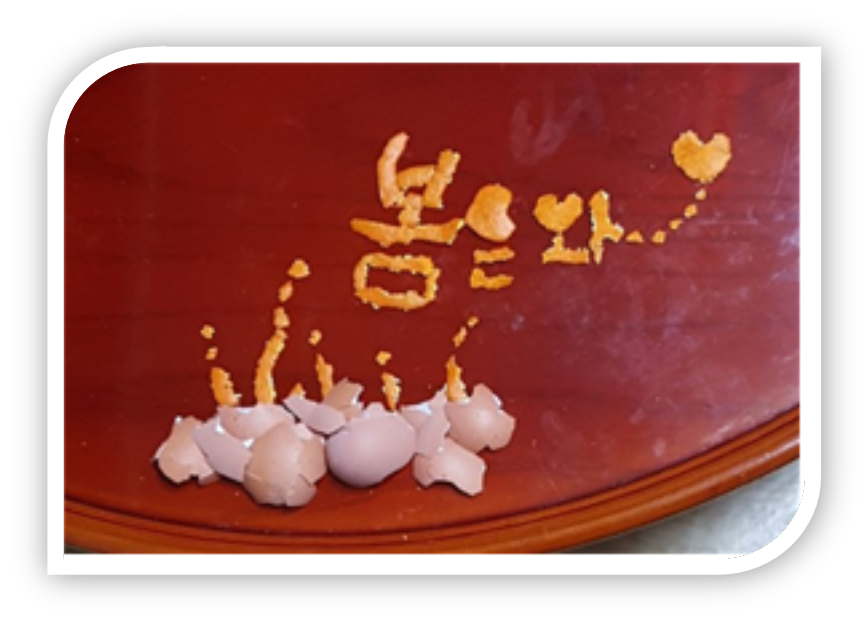
Healing Santa’s spring will come — Even while suffering from the after-effects of a car accident, I always sang of hope in my heart. Just as spring surely comes after a cold winter, I expressed through a PuNolChi Mind Journey the sprouts breaking through an eggshell that symbolizes a rock, and the spring of hope that is coming.
Teaching the Food Expressive Arts Therapy professional course in 2008, I often told my learners about a new expressive-arts Health Table at the level of preventive medicine — preventing illness before it comes. I want to say that if we take time at every daily table to train our own happiness with the PuNolChi Mind Table, grounded in positive psychology and brain science, the number of visits to the hospital will gradually decrease.
I grew basil and made a happiness sandwich to eat.
The first book of the Psychology on the Dining Table series is the e-book “Psychology on the Dining Table: PuNolShi,” published last year. Now other books are being prepared to see the light of day. To build this website, I shared writing from the Mind Table series book “The 5-Minute Positivity Table.” Next, I plan to collect real-life cases into PuNolChi books in the PuNolChi Mind Journey series with various titles, such as “The 5-Minute Gratitude Table,” “The 5-Minute Miracle Table” and “The 5-Minute Joy Table.”
A grateful heart
I am grateful for nearly 20 years of Food Expressive Arts Therapy research together with Dr. Kang Min-ju (Bora) and Dr. Kim Min-yong (Pooh). For more than ten years, Bora has been making and sending me PuNolChi emotion cards filled with morning positivity. Recently she has made friends with ChatGPT, and on mornings when she turns PuNolChi artworks into emotion cards and sends them to me, I begin a special day.
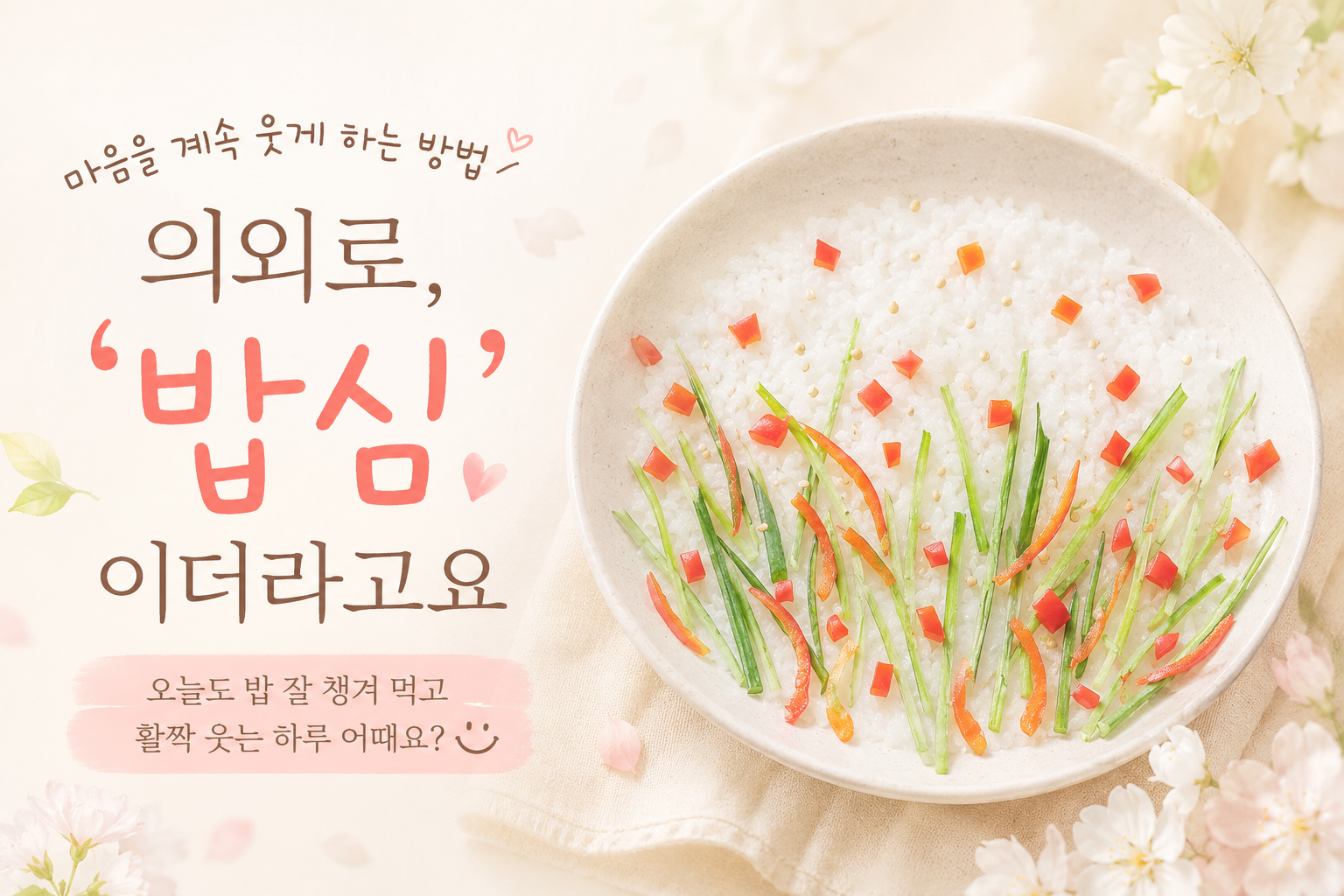
It is all the more precious because it is a one-of-a-kind artwork expressing the heart of this very moment.
From the moment we are born, we are social beings who carry a respect for humanity — wanting to be loved and to share love. If we share a Love Table, filled with the love that fundamentally exists within us, with others, good relationships can naturally expand through the PuNolChi Mind Table.
Through PuNolChi, the Psychology on the Dining Table, I hope that a K-Culture of “Peace Tables and Love Tables, where we eat a healthy and happy heart,” will spread health and a beautiful culture throughout the world.
Though race, language and culture differ, “eating” is a language shared by all humankind. Confirming our strengths through the food we eat every day, “chewing” those strengths deliciously and cultivating a healthy and beautiful inner life — that is the value and ultimate purpose of the PuNolChi Mind Journey that we authors dream of together.
Now that you know the word PuNolChi, I hope you will turn your table into a “mind-cooking laboratory for eating health and happiness.” Just five minutes is enough. The miracle — your strengths coming alive like fluffy grains of rice, and your life beginning to flourish — starts right now, at the tip of your chopsticks on your table.
I hope the PuNolChi happiness project, begun in Korea — a miracle nation of 50 million people — will bring a PuNolChi table of peace and love to the hearts of people eating meals on planet Earth. And I sincerely pray that the lives of people on this planet will flourish. Cooperating, even a little, so that the world becomes more beautiful and better to live in while we are alive — that is the common mission of all of us who practice PuNolChi.