Hello, this is Healing Santa, Kim Ji-yu.
Early one morning in January 2019, while I was still struggling with the after-effects of a traffic accident, I woke up, opened the Bible and prayed, “Lord, please give me wisdom.”
The name I wrote down in my notebook that day was Nathaniel Branden — the American psychologist often called the father of self-esteem.

Today, seven years later, I take out and read again the post I left on my blog under the title “Improving Self-Esteem 1.”
These days the word that stays longest in my heart is “encounter”: meeting good people and becoming happy within good relationships.
As I wondered where that begins, I found myself coming back, in the end, to the encounter with myself.
1. Self-esteem: two beliefs within me
Branden described self-esteem like this:
“The disposition to experience oneself as competent to cope with the basic challenges of life and as worthy of happiness.”
So two beliefs live together inside self-esteem:
self-efficacy, which says “I can do it,” and self-respect, which says “I am precious and I deserve to be happy.”
If, because of someone's single remark, we keep repeating to ourselves “You can't do it” or “You don't deserve that,” then in that moment our self-esteem has been hurt.
Virginia Satir, the great family therapist, also said that self-esteem is what most shapes a person's life, and that when counseling relationship problems it is no exaggeration to focus on raising self-esteem. I deeply agree.
2. Why do encounters sometimes hurt?

Meeting people over many years, I have seen so many who were hurt in relationships and left halfway.
When self-esteem is low, the unfamiliar and the new become uncomfortable, and that discomfort bursts out in relationships as attack or suspicion — sometimes in open clashes, sometimes in talk behind someone's back that wounds the relationship.
We may try to build a false self-esteem from things others can see, such as popularity, wealth or power, but the heart stays anxious and empty, and sometimes we try to fill that psychological hunger with meaningless chatter, shopping or food.
Branden said that the higher our self-esteem, the more open, honest and appropriate our communication becomes, and the lower it is, the more muddled and evasive.
He also left these words:
“The first love affair we must consummate successfully is the love affair with ourselves; only then are we ready for a relationship with someone else.”
It must mean that happy encounters come not from choosing the other person well, but when I, with healthy self-esteem, am ready first.
Fallen leaves on the ground are fine even when they are stepped on again and again, because they know the way of nature.

3. The first pillar: awake, conscious living

Branden spoke of six pillars that support healthy self-esteem:
living consciously · self-acceptance · self-responsibility · self-assertiveness · living purposefully · personal integrity
The very first of them is “awake, conscious living.”
In Branden's words, living consciously means being fully present in what I am doing now, seeking to know what bears on my values and goals, and being aware of both the world outside and the world within me.
At its root is respect for facts as they are — not seeing only what we want to see, and not turning away from uncomfortable truths.
There is a reason Branden called these “pillars” and yet insisted on calling them “practices”: they are not something we do only when we feel like it, but an attitude to life practiced steadily every day.
So self-esteem does not come from someone's praise or from a great success; it is the fruit of small practices that begin within me and pile up through repetition.
4. Staying awake in our encounters

Awake, conscious living is not as easy as it sounds, because in relationships it means looking at both sides with objective eyes and seeking fairness.
It was like that in Jeju that day. After a short phone call with a parent, my heart ached, because I could feel the chain of the heart handed down from the family of origin and the wounds showing within it.
At that moment I held on to just one thing:
“Did this encounter make me feel better or worse?”
Looking at myself with the eyes of an awake observer — noticing for myself in which relationships my mood collapses and in which moments my self-esteem is hurt.
Only with this awareness, instead of blaming the other person or putting myself down, does an encounter become possible in which I protect myself and still embrace the other.
Branden said that seeing the world with my own eyes and living by my own judgment, rather than repeating other people's thoughts, is courage and self-trust. An awake person can meet others as they are, not through rumors or prejudice.

The saying that people are more beautiful than flowers truly rings true only when we meet them with awake eyes.
5. As a small acorn becomes an oak
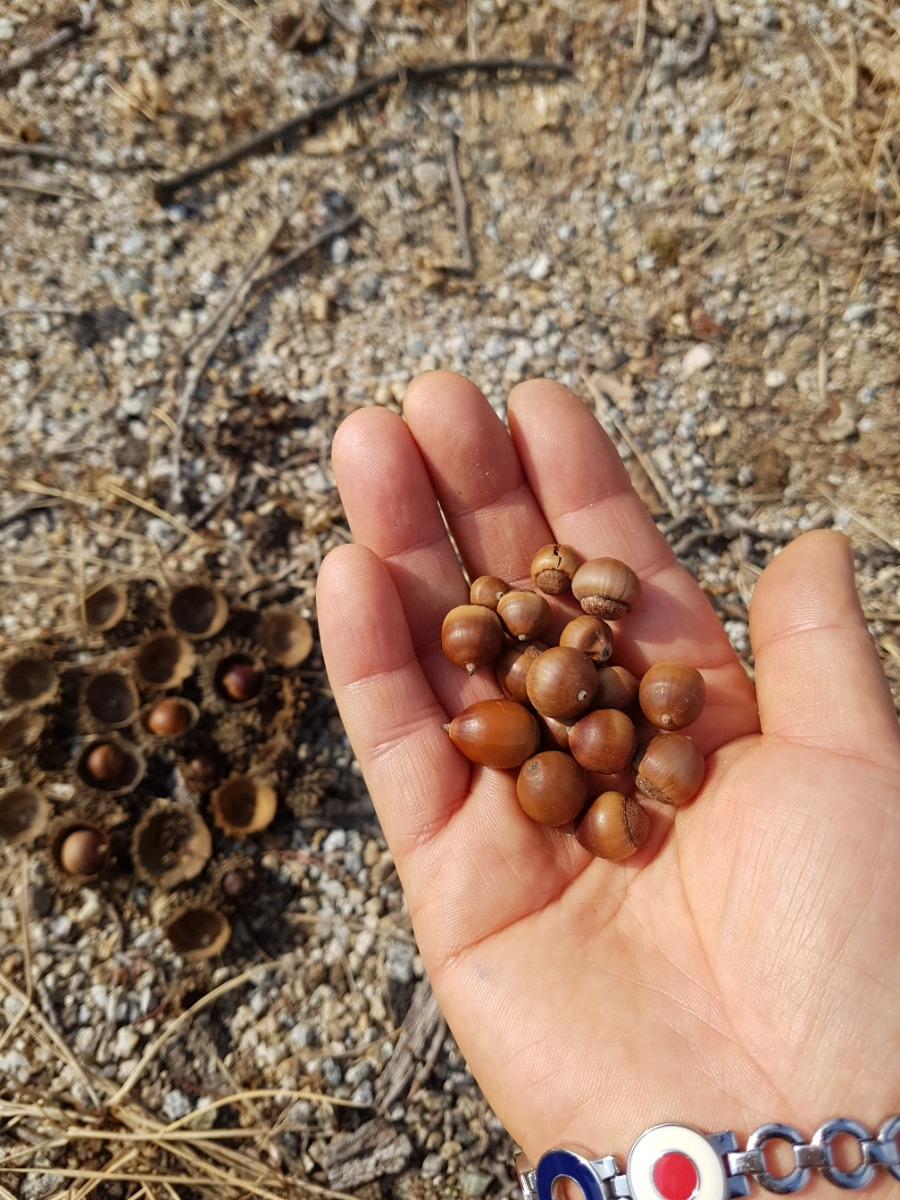
On my walk that day I picked up a handful of acorns. Decades ago, one small acorn like these must have fallen to the ground and become that great oak tree.

Even if my form disappears and changes, that does not make me someone else. Always, anywhere, I am simply me — though a flexible attitude that suits the situation is certainly needed.
Self-esteem grows the same way. The small awareness of trying to stay awake day after day one day becomes a sturdy tree that gives rest to me and to the people beside me.
6. Today's 5-minute mind practice

Borrowing Branden's favorite “sentence completion” exercise, try it slowly, as if savoring a PuNolChi 5-minute Mind Table.

One. Think of someone you met today and complete this in your heart: “When I was with that person, I felt ___.”
Two. Do not judge that feeling; simply look at it as it is — good if it was good, uncomfortable if it was uncomfortable.
Three. Then continue like this: “If I am a little more awake in tomorrow's encounter, I will ___.”
Five minutes of slowly savoring the day's encounters, the way you chew a spoonful of rice and notice its taste. Those five minutes will become the first key that opens happy encounters.
Closing

Happy encounters are not luck that comes from outside; they begin with an awake me, a me with healthy self-esteem.
When I notice myself as I am, I can also see the other person as they are, and with the people we meet that way we build relationships that give each other life.
In the next story I will come back with the second pillar, “self-acceptance: embracing myself as I am.”
In which encounter today did you meet your “awake self”?
Healing Santa Kim Ji-yu
References: Nathaniel Branden, The Six Pillars of Self-Esteem; writings on Branden's official website; Healing Santa's blog post “Improving Self-Esteem 1” (2019.1.23)
This story was first posted in the PuNolChi Mind Journey healing writing of the healing space Haengbok Yeolgi cafe.